NewtonPoint.
I was an early adopter of Newton technology back in 1993 when Apple shipped their first Arm 610-powered Newton device. Newton was launched to much fanfare but by 1995, sales were flagging. So Apple UK ran a competition to design an application or service for the Newton line. Of course, I entered the competion! And while I didn't win, my “NewtonPoint” proposal came in at a very respectable second place - winning me the usage of a Mac for three months, together with the NewtonScript SDK and other development assets I'd need to produce a proof-of-concept of my proposal.
NewtonPoint was a system that would provide the user with location-specific information beamed via infrared from strategically placed points (NewtonPoints) to their Newton. For example, the NewtonPoint at the entrance to a shopping mall would beam a map of the mall to the user's Newton as they entered the mall. This might also include any special offers, etc.
But, because the infrastructure required would have been much too costly to implement, Apple didn’t proceed any further with NewtonPoint after I completed the proof-of-concept of the client software.
The idea still bugged me, though. So, a few years later, (after Newton had been discontinued in 1998) I proposed an updated version of the concept called iPoint.
While the iPoint concept was very similar to NewtonPoint, one big difference was that is would be device-agnostic, meaning that it wasn’t tailored to Newton devices specifically. Instead, any handheld device could use it, including Palm Pilots, Windows CE devices, BlackBerries, Nokias, and more.
Read more about the updated iPoint concept below.
iPoint
I wrote this explainer about iPoint in 2001. I’ve copied the text below verbatim from my original document, so some things might seem out of date! But this was the state of the union of the time. It’s a long read, but some might find it interesting!
iWhat?
An iPoint is an Information Point. It's intended to be an easy means of delivering useful information to individuals. Roaming, mobile, nomadic, or casual users will be able to retrieve, view and query information about their immediate location or surroundings from iPoints using Pocket PC's and handheld communicators. This information will be tailored to the users' needs, preferences or tastes. It is a brand new type of application which is ideally suited to handheld computers and the new communicators which are emerging. It's something that could become the 'killer application' for this market - eventually, I believe that this type of service will be as common place and easy to use as the telephone.
Backgrounder
The handheld or PDA marketplace has been slowly growing and gaining momentum over the last few years with established machines such as Psion's 3a and 5, the Palm Pilot, numerous Win CE devices and others from the likes of Sharp, Casio becoming increasingly popular. In addition, new breeds of device such as the communicator and Pocket PC are entering the arena. These are the devices which will drive the mobile information revolution.
The earlier incarnations of these machines were little more than electronic organisers with limited capabilities or scope for development or expansion. The current devices, however, are very different and, in contrast, have a great deal of scope when it comes to development and expansion. They also have much advanced capabilities and functionality. Communicators go one step further and have extensive communications facilities built in. As this market grows, therefore, more & more people will be carrying around with them relatively powerful pocket computers which can perform a wide range of functions. Most of them, however, will still be used as diaries and to-do lists. All that power and potential going to waste. Now with the introduction of communicators and Pocket PCs using Wap and even Java, the time has come to introduce a worthy service.
The Internet shows that people's thirst for information is insatiable and so Internet access and compatibility is being built into the current and next generation handhelds. This is fine, however web pages are designed to be best displayed on full size, high resolution colour monitors - not the, (relatively), low res, monochrome miniature screens which most handhelds have. In addition, there are connection fees and subscription fees to be paid by the individual to access information on the net. Most 'techy' types will be OK with this, but the not-so-techy types won't. Internet compatibility, then, will be very important to handhelds but it's not the ideal way of obtaining information. WAP is on the horizon - and while this new technology is sure to cause a stir, it will have it's limitations.
What is needed is a simple, free and useful method of accessing information specifically designed for, and to be displayed on, handhelds or communicators. iPoint fits the bill. The information you receive is tailored to each individual user. The information is location specific - i.e. the information you receive is related to your current whereabouts such as a shopping centre or DIY store.
iPoint
iPoint is a system where users equipped with handheld devices can download content rich data and information at points located at strategic and convenient places.
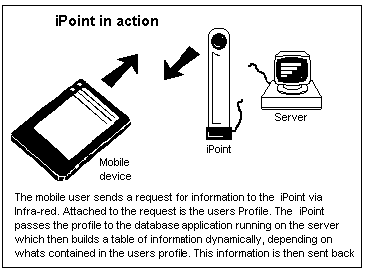
The iPoint itself is floor standing or situated in a wall outlet - much like a cash machine. It is connected to a 'server' via traditional networking means. The server, (Pentium based PC), contains all the information that will be downloaded to the iPoint client software on the mobile device. The software running on the communicator will probably be called ViewPoint. It is a browser which is used to view iPoint information much in the same way as Netscape or Internet Explorer is used to view Internet pages.
This would allow the user to walk into, say, a shopping centre and download a directory or map of the centre into the mobile device. Then, using the ViewPoint software, the user could query and obtain information about the centre from the information held in the device, and know immediately where, for instance, a particular shop or convenience is located. The user could also view information about sales and other special offers being promoted in the centre. Using a simple query/search option would enable the user to easily identify shops selling particular products or services. As WAP will be supported on future handheld devices, WapAds, in the form of Wap applets, could be used for advertising goods and services.
All of the information downloaded and accessed via an iPoint will be specifically tailored to the ViewPoint user. This will be achieved via a user profile which accompanies each request for information. The user profile contains such information as tastes in music, cuisine, film, literature and arts as well as information such as the users age and sex.
Imagine walking into a music store and downloading the latest price lists, or being told of the latest releases that month for your favorite type of music or from your favorite artist - or going to a train station and downloading the timetables - or maybe walking past a travel agency and downloading the latest holiday information and prices from the iPoint in the window. (Remember, the holiday information you've just downloaded is specifically about the types of holidays you like to take as this is all detailed in your profile). The applications where iPoint could be used are countless.
The information would be downloaded in the form of 'booklets'. These booklets would be managed by the ViewPoint software which could discard them at will or save them for viewing later or downloading to maybe to a PC or Mac at home or work.
The mobile device then becomes a real assistant and communicator. Gathering information about your environment, (selectively, depending on what you've told it to look out for), and making it available to you quickly and easily.
iPoints could be useful in many environments, including travel stations, where the user can get up-to-the minute travel information including the frequency of buses, trains, etc. Places like museums or other public attractions will have iPoints which will give patrons valuable information about that particular place and the exhibits being displayed. This information will probably include interactive maps which guide the user around the exhibits. Again, information could also be retained in the device and downloaded later into a PC at home or work.
Banks, Restaurants, Cinemas, etc. will all benefit from the iPoint information system.
Consumers, however, will benefit the most. iPoint will be the next communications and information revolution. A technology that will touch the lives of millions just as the telephone has done. It will also be a major boost to the take up of mobile computing and is set to be the 'killer application' which the handheld market is looking for.
The iPoint Architecture
The iPoint Architecture will consist of:
The iPoint itself - Either a dedicated floor standing or wall mounted unit. The iPoint exchanges information with handheld devices via wireless technology such as Bluetooth.
IBM PC's utilising an Oracle database - these will act as the servers. Only one would be necessary for most installations as multiple iPoints would be attached to each server.
Oracle SQL application - this is the software which will run on the server. Information can be entered directly into the application or imported from existing databases. As many companies already use software for stock control and EPOS, gathering this information couldn't be made easier. The information would then be compiled and stored in the database ready for downloading to the relevant iPoint.
Mobile Application - ViewPoint would run on the mobile device itself. This program would handle the display of information passed from the iPoints. It would enable you to navigate the iPoint booklets which have been downloaded into the mobile device.
Mobile Device - this is the hand held device into which the data will be downloaded. The system has to be as open as possible to encourage usage.
iPoint Q&A
What is a iPoint?
An iPoint is an Information Point. It's a dedicated floor standing or wall mounted unit which has a wireless transceiver utilising Bluetooth technology built in. An iPoint is connected to an Oracle database running on a remote machine via traditional networking technology. The PC can be located in the iPoint itself or held in a central location if multiple iPoints are being serviced by it
Can any machine make use of it?
Any handheld device can work with it as long as there is a version of the ViewPoint software which can run on the machine.
What is a 'Booklet'?
A booklet is a collection of data which is downloaded to the mobile device after a request has been made. It is a dynamic database created on the fly by the Oracle server software in accordance to the users profile. In time, booklets will become as commonplace to handheld users as 'files' and 'documents' are to PC users.
What about the 'Server Software'?
The software which will run on the server will be an Oracle database application, (or similar), which allows users to either quickly enter information directly into it or import it from another source. It is this information which is then queried via the iPoint. The software will look at the users profile which is sent by the mobile device, build a database specific to that user and return it as a booklet. ViewPoint would have to assign an ID to each request. The software then returns the booklet with the same ID. This ensures that the correct person gets the correct booklet. The Oracle database could be updated as often as the iPoint operator thought necessary - once a day, once a week, once a month, etc. - depending on the type of information contained in it.
Who will pay for the iPoints?
The company/shop/serviceprovider that operates it. Initially, iPoints would probably only be used in places like shopping centers and travel stations. Eventually, though, iPoints would be much more widespread. Individual shops will have them.
What benefit will they get from operating a iPoint?
When a company installs an iPoint, one of the major benefits they will see is that they will get much more of an insight into their typical customer. This is because the profile of every user, (which is sent with every request for info and determines what information is returned), can be kept and analyzed by the person operating the iPoint. This would enable the company to get to know their typical customer better and become more in tune with the customer in the way they sold and promoted goods.
It's something which all chain stores would like to do - get each and every customer to fill in a questionnaire about their particular tastes whenever they enter the store. The profile will not contain any personal information such as names, addresses or telephone numbers.
This is an important point. It means that iPoint will bring benefits all round - it will provide users with important, tailored information about their surroundings and environment and it will also provide the store operating the iPoint valuable information about it's customers.
What about Java and WAP?
If the handheld supports Java or WAP then applets could also be downloaded and executed through VewPoint. Again, because your profile is sent with a request for information, the information which you receive will be specific to your interests. This means you could visit a bookstore and, (because you're interested in boxing), the WapAd of the latest autobiography of Mike Tyson is downloaded together with your normal booklet containing info about new releases, etc.
How will the consumer benefit?
The consumer will benefit from becoming more informed and from the convenience of having 'information at their fingertips'. As well as iPoint being a consumer product, the principal could easily be used in any environment - imagine mobile sales reps downloading the latest information, both general, and specific to their clients, on a Monday morning at the office before they hit the road.
~~~ fin ~~~
Some companies, including Microsoft, showed interest in the iPoint idea. However, ultimately, none were willing to help me push the idea forward. I eventually gave up on the idea, and moved on to my next project: TopPocket.com. But what a great journey. And what a great learning experience!